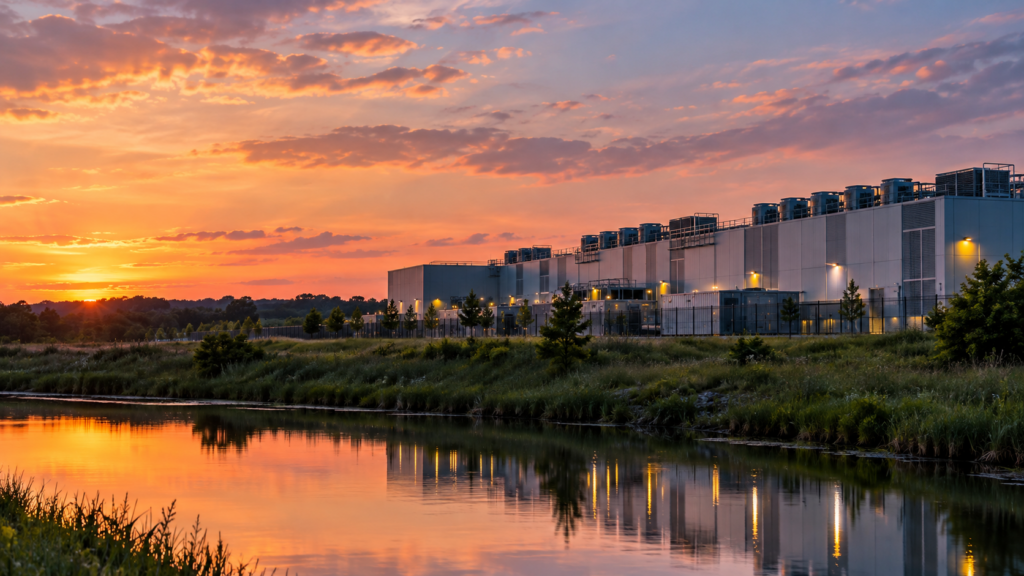
As data centers rapidly expand across the country, Pennsylvania communities are confronting growing concerns about potential health risks that these facilities pose to the public and our environment.
More than 80 hyperscale data centers designed to power artificial intelligence are planned in Pennsylvania alone, including five already under construction and another five already approved. Each data center will bring industrial-scale diesel generators, stored fuel, and heavy demands on power and water.
Notably, Pennsylvania sits at the center of the PJM Interconnection, which is the largest power grid operator in the United States serving 67 million customers. PJM projects roughly 32 gigawatts of additional peak electricity demand by 2030, with about 30 gigawatts or roughly 94%, coming from data centers. 30 gigawatts is equivalent to the combined generating capacity of 30 large nuclear reactors which could generate enough electricity annually to power three average-sized U.S. states.
Pennsylvania’s top utility regulator has warned that if data center growth outpaces new power plants by 2030, the Commonwealth could experience as many as 13 loss-of-load events per year, which are times when the grid can’t supply enough power and operators must cut electricity to some customers.
But power grid usage is not the only concern. Large data centers can have power systems consisting of dozens of massive diesel generators—each roughly the size of a train car. Backup generators can emit up to 4,200 tons of nitrogen oxides, which is about the same as a mid-sized coal plant. The main health concerns from air pollution from these generators come from fine particles in diesel exhaust and nitrogen dioxide. Research also links diesel exhaust exposure to asthma, cancer, and cardiovascular disease, with children and older adults especially vulnerable.
The massive amounts of fuel stored on-site to power emergency backup generators are possibly the biggest risk. Data centers commonly use backup diesel systems with underground fuel storage tanks. Underground storage tank leaks are a common source of groundwater contamination. Leaks from storage tanks, fuel lines, and transfer systems can release fuel and hydrocarbons into surrounding soil and groundwater, contaminating drinking water and nearby waterways before anyone discovers the releases. For neighboring communities, these incidents can mean costly environmental remediation, diminished property values, and prolonged health concerns due to exposure to hazardous chemicals. Just last month, more than 5,000 gallons of diesel fuel were leaked from a data center storage tank into a tributary of the Hackensack River in Secaucus, New Jersey. According to the facility operator’s investigation, malfunctioning valves during routine diesel-fuel maintenance caused 5,200 gallons of fuel to overflow a secondary containment and enter the facility’s stormwater drainage system. The New Jersey Department of Environmental Protection confirmed that diesel contaminated a Hackensack River tributary, requiring extensive cleanup.