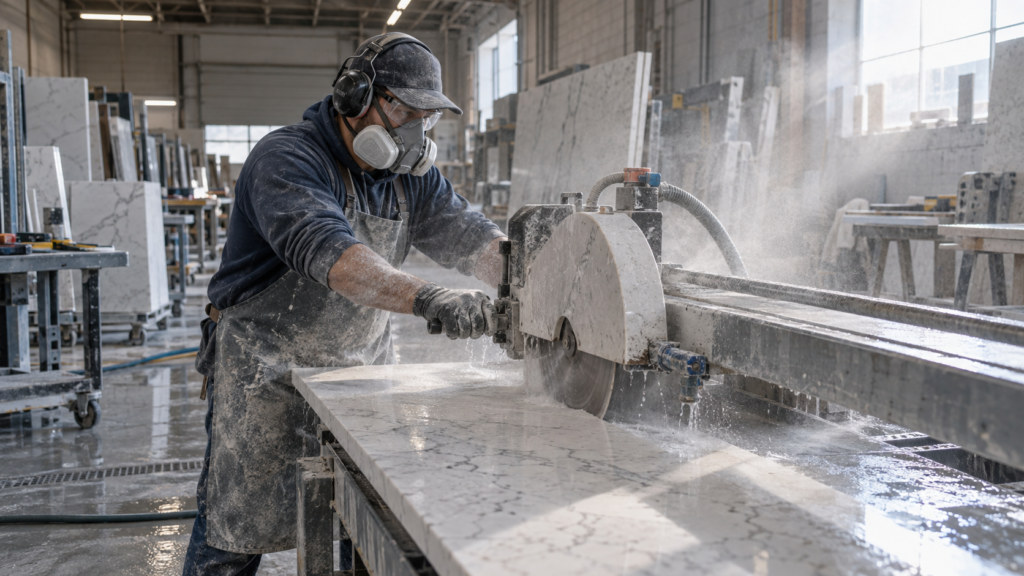
New quartz countertop material, sometimes referred to as artificial stone or engineered-quartz, contains extremely high concentrations of crystalline silica. Cutting, grinding, and polishing the slabs of artificial stone releases respirable silica particles capable of penetrating deep into a worker’s lungs and causes silicosis, an incurable disease sometimes requiring lung transplants or resulting in death.
Silicosis is not new. The danger of inhaling mineral dust was recognized as early as the first century A.D. by Roman authors. However, quartz countertops found at major retailers like The Home Depot are very different from the natural slabs of stone quarried and carved since antiquity. Traditional engineered-quartz countertop material is a manufactured composite made by combining crushed or ground quartz—crystalline silica—with polymer resins, pigments, and other ingredients. NIOSH reports that the material contains more than 90% crystalline silica, whereas marble often contains less than 5% and frequently around or below 1% depending on where it is sourced.
Now, what began in the fabrication shops is moving into the courtroom. Stone cutters are suing the manufacturers and distributors of quartz countertops alleging that they knew ordinary fabrication could generate dangerous levels of silica dust but failed to warn workers about the true health risks. The wave of civil litigation is not the first time these claims have been raised.
In 2023, five workers in Vigo, Spain developed silicosis after years of fabricating quartz products, including products sold under the Silestone brand. Spanish authorities pursued criminal charges against the president of Cosentino, the company that manufactures Silestone. The prosecution resulted in convictions and an award of €1.1 million in compensation to the workers. The court records showed that concerns about worker safety dated back to the early 2000s, but went ignored.
For the stone cutter, the controversy is brutal. Workers spend entire shifts inside a dust cloud made from the countertop material. The saw bites into the slab and a pale haze of dust hangs in the air and coats hair and clothes while invisible particles travel deep into the lungs. Years later, a diagnosis of silicosis likely does not reveal itself as a dramatic accident, but as the inability to do something as basic as taking a full breath.
Who should bear that cost—the worker who inhaled the dust, the shop that controlled the fabrication floor, or the corporations that designed, marketed, and sold the material, and knew what it did to people? The question is no longer what we know, but who will be held accountable for ignoring it.