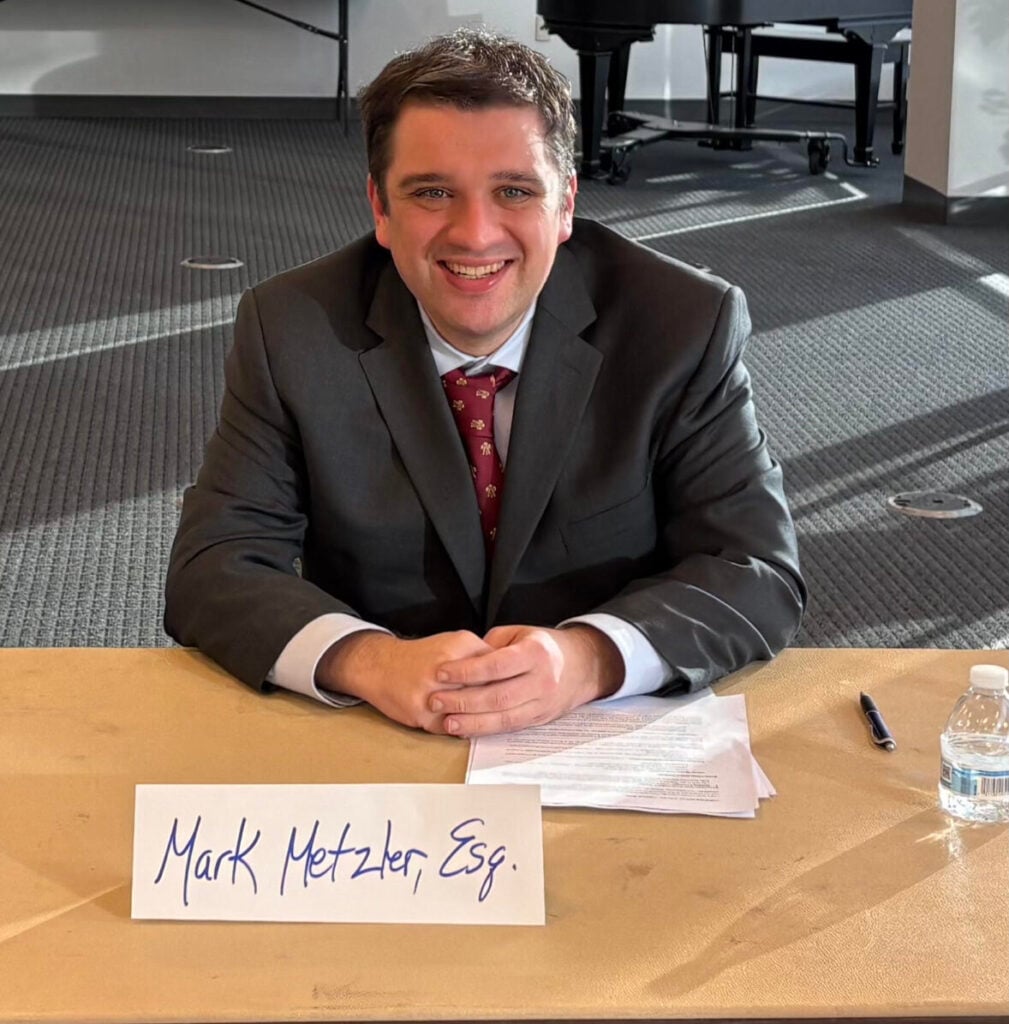
Less than a year ago, Mark Metzler was still waiting on bar exam results. Today, he’s drafting 90-page complaints, arguing in Philadelphia’s discovery court, and learning the complex litigation associated with benzene cases from partners. The reason Mark feels he is working like this, rather than the routine tasks typically assigned to first-year associates, is a tribute to one thing: the people around him.
Mark’s path to Locks Law didn’t start in law school. It started with a CPA exam, passed junior year at La Salle University, and four years in Big Four accounting at KPMG, which his trained financial upbringing made him feel was a “safe path,” guided by two accountant parents. Despite his initial path, Mark never abandoned his dream to become a lawyer. The pandemic gave him time to study for the LSAT, and in 2022, he enrolled at Villanova Law, assuming his accounting background would guide him toward transactional work.
It didn’t take long to discover otherwise. Litigation classes caught his attention. Mark loved the anticipation and the prep for the back-and-forth. Compared to auditing large public companies, where skilled internal teams often made his work feel more like box-checking than problem-solving, litigation felt alive. And plaintiff’s work, in particular, felt like something worth doing: a sort of Robinhood for clients.
The open-door approach at Locks Law, with associates learning from partners, means questions get answered right away, a marked-up draft has seasoned first-degree comments, and learning moves at a faster yet intimate pace. Where some large firms load associates with 150 cases apiece, attorneys at Locks carry closer to a dozen. That ratio isn’t just about workload; it’s about how much attention each client gets, which translates to unprecedented mentorship and client experience.
There’s also a practical upside to Locks’ size: nothing gets filed “just in case.” He’s watched friends at large defense firms spend two weeks on motions that never see the light of day. At Locks, the work that’s built is used—a dynamic that keeps the client’s needs as the top priority.
Most of his docket is benzene litigation, a specialized, demanding area of plaintiff’s work, and not every firm can staff it. “My goal is straightforward: keep learning, keep taking benzene cases and whatever comes next, and continue developing as a litigator.”
For a firm built on mentorship, Mark’s trajectory is one more example of how Locks Law approaches plaintiff law differently.