What Death Match Wrestling Reveals About the NFL’s CTE Crisis
When I step away from concussion litigation for a night, you might catch me in a dimly lit arena watching light tubes shatter, barbed wire tear, and wrestlers bleed for their craft. Yes, I’m one of those people who loves death match wrestling. And no, the irony isn’t lost on me.
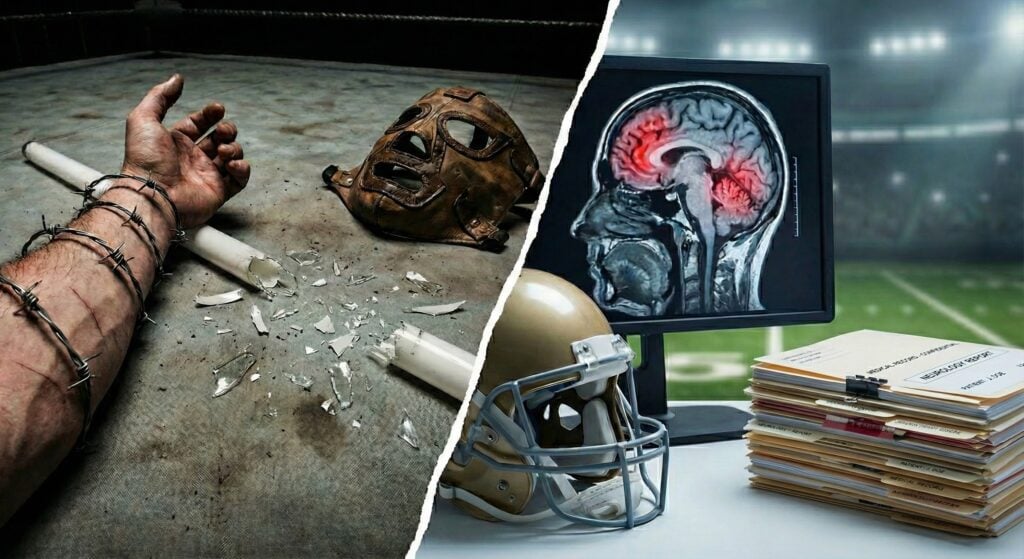
Death Match Wrestling vs. the NFL
Death match wrestling isn’t new. It took shape in Japan in the 1980s, where promoters swapped ropes for barbed wire and even staged matches with exploding rings.[1] The style crossed into the U.S. in the 1990s, with Mick Foley introducing “hardcore” wrestling to a wider audience and Nick Gage—my personal favorite—emerging as its most infamous star. What has always defined the genre is its brutal honesty: wrestlers know the risks, fans know the risks, and nobody leaves confused about the price of admission.
The NFL, by contrast, built its empire on denial. For decades, concussions were brushed off as “dings,” memory lapses dismissed as simple aging, and the long-term toll—CTE, Parkinson’s, ALS-like symptoms—was minimized or hidden altogether. Players sacrificed their bodies just like death match wrestlers, but they were never told the truth about what those hits meant.
The Numbers Don’t Lie
The science is overwhelming. A 2017 study of deceased NFL players’ brains published in JAMA found CTE in 110 out of 111 examined—an astonishing 99%.[2] Repeated concussions increase the risk of neurodegenerative disease several-fold, and athletes who begin tackle football before age 12 face a significantly greater risk of long-term cognitive problems.[3]
The NFL’s Concussion Settlement was supposed to take this reality into account. The deal promised that when a qualified doctor diagnosed a former player with serious impairment, that medical judgment would be respected. In fact, the Amended Settlement Agreement specifically requires that the Claims Administrator defer to a physician’s clinical judgment, particularly where impairment is obvious.[4]
But in practice, that hasn’t always happened. Instead, claims are often subjected to “rescoring”—a process where test results are reanalyzed on paper by consultants who never met the player. These consultants, called AAPCs, are only meant to provide advice. The appeal doctors (AAP physicians) are not supposed to be bound by them.[5] Yet too often, their opinions end up driving denials.
Other safeguards have also been ignored. The settlement prohibits the use of race-based adjustments in cognitive testing,[6] and it only allows rescoring in narrow circumstances where it might help—not hurt—the player.[7] The Special Master overseeing the program has said the standard should be simple: if a physician’s diagnosis is reasonable and supported by the record, it should stand.[8]
And yet, families continue to see valid claims downgraded or denied, caught in a system of red tape that feels far removed from the deal they were promised.
Nick Gage, Tom Brady, and Aaron Hernandez
Nick Gage, known as the “King of the Death Match,” has been slashed with glass, cut open with pizza cutters, and once literally died in the ring before being revived. His appeal isn’t just his toughness—it’s his honesty. He doesn’t hide the damage. His fans don’t pretend it’s safe. The exchange is ugly but transparent.
The NFL’s model has been the opposite. It glamorized the violence while hiding the cost. That’s why the analogy to Tom Brady matters. Brady was the face of the sport, protected not only by his offensive line but by league rules that made quarterbacks nearly untouchable.[9] He was marketed as proof that football’s heroes could endure for decades, retiring celebrated and intact.
But most players were not Brady. They were more like Junior Seau—absorbing constant hits in the trenches with little protection. After Seau’s death at age 43, doctors found advanced CTE, one of the most severe cases ever seen in an NFL player. The contrast is stark: Brady represents the NFL’s carefully constructed facade, while Seau exposes its buried reality.
By elevating Brady, the league concealed the truth. The protective narrative around its stars wasn’t just about wins and highlight reels; it was part of how the NFL hid the dangers from players and fans alike.
Final Bell
Sitting ringside at a death match gives me clarity about the work I do. Violence sells, but ethics depend on honesty. In wrestling, the scars are real, and nobody pretends otherwise. In football, the scars were just as real—but the truth was concealed until it was too late for thousands of players.
[1]Frontier Martial-Arts Wrestling history, founded by Atsushi Onita (1989); see also Mick Foley, Have a Nice Day! (1999).
[2] Ann C. McKee, et al., Clinicopathological Evaluation of Chronic Traumatic Encephalopathy in Players of American Football, JAMA 318(4):360–370 (2017).
[3] Robert Stern, et al., Age of First Exposure to Tackle Football and Chronic Traumatic Encephalopathy Risk, Neurology 90(17):e1571–e1579 (2018).
[4] Amended Class Action Settlement Agreement, § 6.4(b).
[5] NFL Concussion Settlement, FAQ 132.
[6] NFL Concussion Settlement, FAQ 380.
[7] Order Approving Modifications to Settlement Agreement Implementing Norming Agreement (Mar. 4, 2022).
[8] Special Master Ruling on Qualified MAF Physician’s Certification that Testing is Medically Unnecessary (May 27, 2020).
[9] NFL Rulebook, “Roughing the Passer” provisions (expanded in 2018).